What Is Tecktonik Dance? The 2000s French Electro Style Explained
What is tecktonik dance? A plain explanation of the French electro-club style, its signature moves, and why it suits short vertical videos so well.
Tecktonik Dance AI editorial team · Updated October 8, 2026

If you have seen a clip of someone with stiff, robotic arms and rolling wrists dancing to fast electronic music and wondered what the style is called, the answer is usually Tecktonik. It is a French electro-club dance that grew out of the Paris club scene in the 2000s, spread across Europe in 2008 and 2009, and has since become a staple of short vertical video — partly because its movement reads so clearly on a phone screen, even in just a few seconds.
This article explains the dance for readers who saw a clip and want context: where it came from, what the moves are called and how it ended up as the basis for a photo-to-video tool. If you want the one-line answer to what is tecktonik dance: a French electro-club style built on a stiff torso and fast, fluid arm work.
What is tecktonik dance, and where did it come from
Tecktonik is a name attached to two things at once: a style of dance and a party and brand identity that grew around it in the Paris club scene in the 2000s. Cyril Blanc is credited as the originator of the brand and the parties, and by his own account did not set out to start a craze — it grew from the club nights into something much larger.
From those Paris beginnings the dance travelled. Through 2008 and 2009 it spread across Europe, appearing in clubs, at street events and, crucially, online, where clips let a movement in one city be copied in another almost immediately. That online spread is the part worth noticing here: the dance was always a video-native phenomenon, learned from footage rather than from a class.
The style is written up in more general terms as electro dance — "Tecktonik" is the French club name it is most commonly known by, and the two descriptions overlap rather than competing. It belongs to the wider family of club dances that emerged around electronic music, and it is danced to fast, hard electro-house rather than to pop or hip-hop tempos.
The vocabulary of the style
Tecktonik is not chaotic movement. It has a recognisable vocabulary, and once you know the pieces you can spot them instantly.
| Move | What it looks like | Why it works on a phone screen |
|---|---|---|
| Arm waving | Wide sweeps of the arms through the air, one after the other | Big shapes fill the frame and stay visible even small |
| Wrist and finger rolls | The hands rotate and curl, adding detail at the end of each arm | Fine motion close to the body, readable in a short loop |
| Fast arm sweeps across the body | The arms cross the chest and snap outward | Strong diagonals that read instantly in a still frame |
| Robotic torso | A stiff, mostly still upper body while the arms move | A calm anchor that makes the fast arms stand out |
| Loose, fluid arms | Shoulders and arms move freely despite the stiff core | Contrast between rigid and loose is easy to perceive |
| Light footwork | Small steps and shifts, not big travelling moves | Keeps the performer centred in a vertical crop |
The defining feature is the split between a stiff, robotic torso and arms that move freely and quickly. That contrast is what makes the style look mechanical and fluid at the same time.
How it reads on camera and sits next to other styles
Some dances are built for a stage and shrink badly on a phone. Tecktonik is the opposite. Its motion happens mostly in the upper body and at arm's length, so the arms fill a vertical frame without the camera needing to follow a wide floor pattern. The movement is also legible at a glance: a viewer understands what is happening within a second, which is exactly what a short feed asks for.
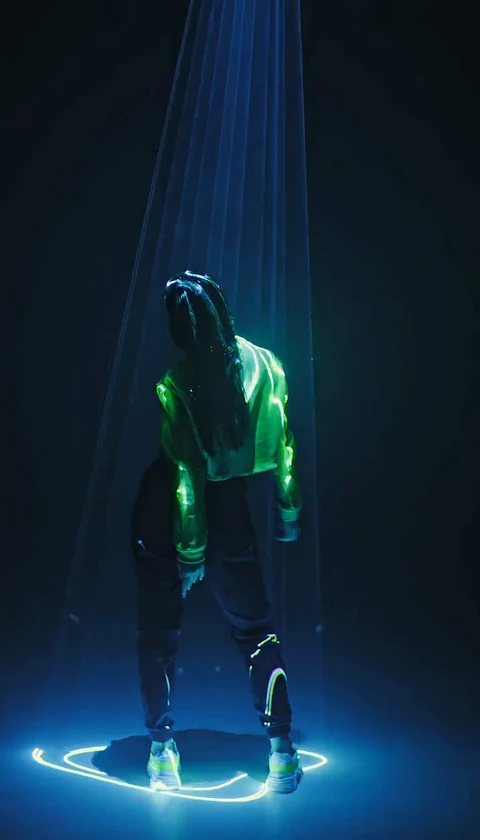
Add the mood — neon club lighting, red stage glow, a retro electro-party feel — and you have footage that looks intentional even when it is only ten seconds long. That combination of a legible move and a strong visual setting is why the style keeps showing up in short video.
How it sits next to other club styles
It helps to place it. Tecktonik is a club and street style with its own signature, distinct from hip-hop and breaking in its footwork and from popping or locking in how it uses stillness. Where popping makes a robotic look from tight, rhythmic muscle hits, Tecktonik keeps the rigidity in the torso and lets the arms sail through big, fast arcs. It is danced to fast electronic music by design, and the tempo shapes everything about it — the dances are quick, continuous and arm-heavy.
From dance to a photo-to-video tool
Here is the part that matters if you are reading this because you want a clip of your own. Learning Tecktonik takes time: the wrist rolls and crossing arm sweeps are genuinely difficult. But you do not have to learn the choreography to get footage of someone performing it. That is what a prepared-scene tool does.
The idea behind Tecktonik Dance AI is simple. Every video starts from a prepared source scene — real Tecktonik movement with its own camera, lighting and length. The tool replaces the performer in that scene with a person from a photo. You upload one adult portrait, or two separate photos for a duet, choose an appearance mode, and the scene supplies the motion while your photo supplies the face. The choreography comes from the scene, not from your text description, so you get the dance without studying it.
You can see the whole flow laid out in the step-by-step workflow guide.
What you actually get
The output is deliberately modest and format-first:
- A short 8 to 10 second MP4, depending on the scene.
- Completely silent — there is no audio track at all. You add music yourself after download.
- Portrait ratios of 4:7 or 24:43, or 131:90 landscape for the two-person trend scenes. There is no automatic 9:16 output, so you crop in the platform editor.
- A cost of 30 credits per standard video. Credit packs are on the pricing page.
Preparation is quick: choose a scene, upload a photo of one adult with a clearly visible face, pick the appearance mode, tick the consent box and create. A failed generation returns its credits automatically. Uploaded photos stay private.
Frequently asked questions
Is Tecktonik a dance or a brand?
Both, historically. It is the name of a French electro-club dance style and also the name of the party and brand identity that grew around it in the Paris club scene, where Cyril Blanc is credited as the originator.
When and where did it start?
It emerged from the Paris club scene in the 2000s and spread widely across Europe in 2008 and 2009, helped by the fact that clips travelled online faster than any class could teach them.
What music is it danced to?
Fast, hard electro-house. The tempo is part of the style — the moves are quick and continuous, which is why the arm work dominates.
Is it hard to learn?
The basic shapes are approachable, but the signature wrist rolls and fast crossing arm sweeps take real practice. If you want the look rather than the skill, a prepared-scene tool lets a scene supply the motion for you.
Why is it so popular in short video?
The movement sits in the arms and upper body, so it fills a vertical frame, and a viewer understands it in a second. A neon club setting plus a legible move is close to a perfect short clip.
Does the tool need music to work?
No. Every clip is silent by design, and you add a track in whichever app you publish to. See the music guide if you want help with that step.
Where to go next
If you want the whole picture, the end-to-end workflow walks through scene choice, photos, appearance modes and download. If you already know the dance and just want ideas for what to make, the video ideas guide has formats that suit a silent ten-second clip. When you are ready, open the create page, preview a scene and try one photo. The tool is an independent product: no artist, music label or social platform stands behind it, and its downloads carry no music.